

Many people think of a Contact Center simply as a system for handling customer phone calls.
In reality, the way customers communicate with organizations has changed significantly. Some customers still prefer to call, but many now choose to start a conversation through LINE, send a message via Facebook, or begin with Live Chat.
When each channel operates separately, agents have to switch between multiple systems, while customers may have to explain the same issue repeatedly.
We have spoken with many organizations facing this challenge. Their existing Call Center systems may still work well for handling calls, but as the number of communication channels increases, traditional systems may no longer meet their needs.
This is why many organizations are starting to consider an Omnichannel Contact Center.
An Omnichannel Contact Center Is More Than Just Putting Every Channel in One Place
Many people understand Omnichannel as simply combining LINE, Facebook, Email, and phone calls into a single interface. While this is part of it, it is only half the story.
The most important element is continuity of customer data and conversations.
For example, if a customer starts a conversation through LINE and later calls the organization, the agent should be able to immediately see the customer’s previous interaction history.
The customer should not have to explain the same issue again.
This creates a smoother experience and makes customers feel that the organization understands their needs.
Why Are Organizations Moving to Cloud Contact Centers?
A Cloud Contact Center makes it easier for organizations to get started without making significant investments in on-premise infrastructure.
It also provides greater flexibility. Organizations can scale the number of agents up or down based on workload and support employees working from different locations.
This flexibility is particularly valuable for organizations that need to adapt quickly to changing customer demand and business requirements.
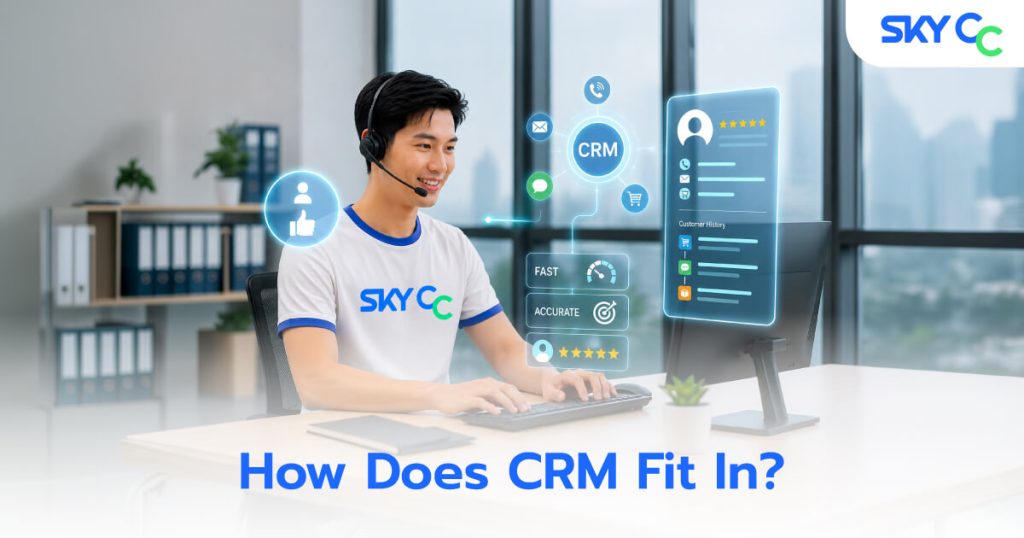
How Does CRM Fit In?
When a Contact Center is integrated with a CRM (Customer Relationship Management) system, important customer information can be made available as soon as an interaction begins.
Agents can access relevant customer information and interaction history without having to search through multiple systems.
This helps agents respond more quickly, reduces errors, and creates a better overall customer experience.
The result is not simply faster service, but a more personalized and consistent customer journey.
Technology Is Only Half the Equation. The Other Half Is People.
Even the best technology can only deliver results when supported by a well-trained team.
Agents need more than technical knowledge. They also need strong communication skills, problem-solving abilities, and a clear understanding of the customer’s business and needs.
A successful Contact Center transformation therefore requires both the right technology and the right people.
Organizations that combine technology with effective employee training are better positioned to turn customer interactions into meaningful experiences.
Conclusion
An Omnichannel Contact Center is more than a tool for handling phone calls.
It connects customer data, people, and communication channels into a more unified ecosystem, enabling organizations to deliver a smoother customer experience while preparing their operations for future growth.
As customer expectations continue to evolve, organizations that can connect every interaction and provide a consistent experience across channels will be better positioned to build stronger customer relationships and grow sustainably.
FAQ
1. What is the difference between an Omnichannel Contact Center and a Multichannel Contact Center?
A Multichannel Contact Center allows customers to contact an organization through multiple channels, but the data and conversations may remain separated.
An Omnichannel Contact Center, on the other hand, connects those channels within an integrated system. This allows agents to access the customer’s interaction history across channels and reduces the need for customers to repeat the same information.
2. What types of businesses should consider an Omnichannel Contact Center?
An Omnichannel Contact Center is suitable for organizations that provide customer service through multiple channels, such as phone, LINE Official Account, Facebook Messenger, Live Chat, and Email.
It is particularly valuable for businesses that want to improve their Customer Experience (CX) and provide more consistent service across every customer touchpoint.
3. If we already have a Call Center system, do we need to replace everything?
Not necessarily.
Many organizations can build on their existing Call Center infrastructure by integrating additional systems, such as a CRM, ticketing system, or digital communication channels.
The best approach depends on the organization’s existing technology, business requirements, and long-term objectives.
4. Can an Omnichannel Contact Center really reduce costs?
Yes. An Omnichannel Contact Center can help reduce service time, minimize repetitive work, improve agent productivity, and provide management with real-time data to support better decision-making.
Over the long term, these improvements can help organizations operate more efficiently and reduce overall costs.
————————–
Thailand’s CX Leader,
Setting the Global Benchmark
E-mail : [email protected]
Tel : +66 2685 0000